Get 10% Off with CodeGET10
RECENT SEARCHES
Recently Viewed

Diving Safety

US Olympic Diving
David Boudia, a 2008 US Olympian diving in Indiana during the Olympic Trial.
Whenever it’s hot out, it’s best to enjoy kicking back in a swimming pool and enjoying the refreshing water. Many families choose to go to a community pool, while others opt to relax in their own backyards. Avid swimmers and daredevils often find themselves poised at the edge of a diving board. However, before jumping out into the water head first, it’s important to bear in mind a few important facts.
Diving can be extremely dangerous. It leaves the head and neck vulnerable to injury, and in extreme cases, it can be tragically crippling or even fatal. The American Institute for Research’s review of spinal cord injury statistics related to diving board use found that, in 2001, diving led to an estimated 11,196 spinal cord injuries. While the study also found that it is ten times more likely to be struck by lightning than it is to sustain such an injury from diving, the risk of diving injuries is heavily increased by diving and unsafe practices while doing so.
Accidents most commonly occur as a result of failing to dive properly, being intoxicated, or not acknowledging the depth of a pool. While many accidents and injuries can be attributed to divers’ personal error, some steps can be taken to ensure that divers are as safe as possible.
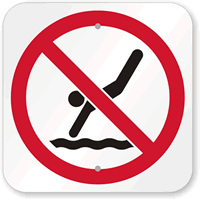
No Diving Sign
Diving signs like these are important for areas that are not safe for diving. Keeping swimmers aware and reminding them to be safe is every pool owner’s responsibility.
Swimmers should never be in a pool or dive unaccompanied. It is always important to have a buddy who can rescue or alert someone in case of injury. Drinking always affects motor coordination and judgment, so it should never be done while swimming in a pool. Furthermore, trick dives, like flips, backwards dives, or handstands are not easily completed. While Olympians may make such feats look simple, in reality, they are extremely dangerous and easy ways to get hurt.
Perhaps the most common direct cause of injury is diving improperly into water that is too shallow. While many pools do not go deeper than 6ft, the National Pool and Spa institute requires a depth of 8.5 feet for diving. The International Swimming Federation, FINA, which sets the requirements for diving pools, requires a depth of 11.5 feet for a one-meter springboard and 12.5 feet for a three-meter board.
Shallow Water Sign
Shallow water is the greatest danger for a reckless swimmer.
Posting proper signs about a pool’s depth is instrumental in keeping a pool safe. Signage also keeps swimmers informed about where they can and cannot dive. Diving off the sides of the pool when a diving board is present can be unsafe, as diving boards are installed over the optimal diving depth.
Finally, make sure all swimmers – especially children – are taught pool and diving safety. This ensures that they will make the right choices when it comes to diving boards and that they’ll avoid unnecessary injuries that stem from ignorance or recklessness.